Skip to content
Geplaatst op: 26 March 2026
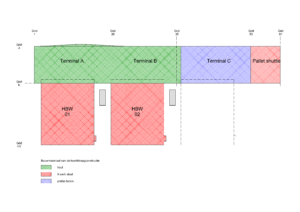
When designing Bestseller’s large wooden distribution centre, we faced a clear challenge: ensuring the stability and vibration control of the structure. Due to the intensive use of machinery and forklift trucks, combined with a relatively light timber floor, vibration nuisance was virtually inevitable. It was crucial to thoroughly investigate this challenge in advance and find manageable solutions. Thanks to thorough preliminary research and realistic requirements, a building that is both stable and comfortable could be realised with relatively minor adjustments.
The floor structure consists of 120 mm CLT (Cross-Laminated Timber), covered with a waterproof membrane, onto which a 120 mm thick concrete floor is poured. It is noteworthy that there is no structural connection between the CLT and the concrete, which makes the vibration behaviour particularly complex.
The building to scale
To ensure certainty, a realistic mock-up was built in advance at main contractor Van de Ven in Veghel. This test setup comprised four columns, main and secondary beams, and a complete CLT+concrete floor, including all fixings and membranes to replicate the actual behaviour as accurately as possible.
A thorough analysis
The vibration behaviour was analysed by Cauberg Huygen, using the following approach:
• a literature review of the required comfort levels for both office and distribution areas;
• measurements on existing machinery to identify the main sources of vibration;
• the creation of an FEM model to predict the impact on the timber structure in advance;
• field measurements on the mock-up to validate the model’s assumptions
The conclusions were clear and directly applicable:
In practice, CLT and concrete work well together in relation to vibrations. Despite the absence of structural connections and the membrane, there is sufficient microscopic interaction.
Please note!
The transition between the office and the distribution area is a critical point. The structure is interrupted and designed with expansion joints at this point, meaning that vibrations require particular attention. The main source of disruptive vibrations comes from forklift trucks placing pallets. By adjusting lifting heights, driving routes and unloading locations, this disruption can be effectively minimised. Vibration-sensitive installations such as pallet robots require a separate, rigid and heavy-duty structure.
The strength of Pelecon
This project demonstrates exactly where Pelecon’s strength lies. Much of what we do is invisible, yet indispensable for a safe and comfortable building. Our tagline ‘the invisible strength’ is therefore not just a slogan: we ensure that structures function stably, safely and reliably, even when you cannot see them.
Geplaatst op: 23 February 2026
Bestseller’s new distribution center (DC) in Lelystad is striking for its enormous amount of wood: 23,500 m³. However, wood isn’t the only material: steel and concrete also play a significant role, with sustainability and low CO₂ emissions being key priorities.
Sustainable design as a starting point
During the preparatory phase, Bestseller commissioned us to design a building with the lowest possible CO₂ emissions and to use bio-based materials wherever possible. The distribution center consists of several building sections with varying functions and loads. Therefore, the structural option with the lowest environmental impact was chosen for each section.
High-bay warehouses and section D: steel with a low environmental impact
Height and large spans were decisive factors for the high-bay warehouses and section D. Steel proved to be the most suitable construction method. Both steel structures are fully detachable and constructed of XCarb® steel, a type of steel with a low environmental impact.
Sections A and B: Timber Construction
In sections A and B, the superstructure is constructed entirely of timber. The floor load on the upper floors is 7.5 kN/m². Wood not only provides sufficient load-bearing capacity here but also contributes to the project’s biobased ambition.
Section C: Precast Concrete and Timber
Section C combines precast concrete floors with a timber roof structure. The floor load on the upper floors is 12.5 kN/m². This hybrid solution provides the necessary strength and stability, while the timber roof contributes to reducing CO₂ emissions.
Greyatter Industrial floors on HS-piles
All industrial floors are constructed of low-carbon concrete: Greymatter from Van Berlo. The Greymatter concept used here involves reducing the cement content through granular packing optimization. The industrial floors at ground level are founded on mini-vibrated piles. These are slender piles that are driven into the ground at high speed. These piles are only suitable for supporting the industrial floor and are not part of the main load-bearing structure. Besides being a highly cost-efficient system, this floor system also achieved the best LCA rating. This maximizes sustainability at the foundation level.

Although timber was not suitable everywhere, materials with the lowest possible CO₂ emissions were deliberately chosen for each section. In a future article, we’ll determine the building’s final LCA value and provide insight into the overall environmental performance of this unique distribution center. Stay tuned to our social media for another Bestseller update!
Geplaatst op: 4 February 2026
At Pelecon in Gouda, we have something new: our canteen has been completely revamped! We prepare the most delicious lunches in the new kitchen. And the seating areas offer a pleasant place where we can recharge our batteries, have lunch together or simply catch up with colleagues.
Our pleasant working environment grows with our team. That’s why we have room for new colleagues at Pelecon: we are looking for talented engineers. Want to know more? Take a look at our vacancies.
Will you be in our neighbourhood soon? You are welcome to drop by for a nice cup of tea!
Geplaatst op: 20 January 2026
At Pelecon, our strength is often invisible, but always essential. At DC Nabuurs II in Haps, we proved this once again: together with Heembouw, we created a modern logistics centre that is efficient, sustainable and completely future-proof for user Foot Locker!
The building, completed in 2024, combines warehouse, mezzanine and office space and is flexibly designed to grow with operational needs. Smart calculations according to FM Global guidelines ensured minimal additional steel load, while wooden facades and an AutoStore system required customisation.
Close collaboration with specialist partners brought together structural knowledge, architectural vision and implementation experience – always with the user at the heart of the process.
Read more.
Geplaatst op: 14 January 2026
This building, BESTSELLER’s new logistics center in Lelystad occupies a whopping 155,000 m2. In a nutshell: the largest wooden building in Europe is being created here!
The architect Henning Larsen, now part of Ramboll in Denmark, chose from the beginning of the design to save as much CO2 as possible and improve biodiversity on the site, despite the building. As a construction material, therefore, as much wood as possible was chosen. For the finish, natural materials were also sought, for example hay as insulation material. Where it could not be otherwise, due to high loads and/or space requirements, prefabricated concrete and low-CO2 produced steel were chosen.
Knowledge step forward
For Pelecon Amersfoort, selected as a local partner by Ramboll Denmark, the timber construction is a huge knowledge step forward. Knowledge of the possibilities, the conditions during execution, the (good) resistance to fire, etc. André Verschoor, register designer of Pelecon: “we expect an explosive growth in the application of laminated wood in the coming years, in combination with wooden hollow-core slabs, for example.”
Increasing biodiversity
The architect’s desire to increase rather than reduce biodiversity on the building site is expressed in a roof garden almost 300 meters long. The roof of the high-rise is (naturally) full of solar panels.
📷 Henning Larsen and Pelecon
In the Hoeverijk district of Nieuwegein, a sports complex unlike any other is being built: the National Climbing Centre Nieuwegein (NCCN). In 2026, the largest and most modern climbing centre in the Benelux will open its doors here. A place where sport, technology and sustainability come together in one impressive building.
What will soon be built in Nieuwegein is more than just a climbing hall. It will be an inspiring sports centre where recreational climbers, families, physiotherapists and top athletes can meet. With a guest house for athletes, bright meeting rooms, a restaurant and comfortable training and treatment rooms, the NCCN is a place where sport, relaxation and well-being come together.
The invisible power of Pelecon
For Pelecon, this project is a wonderful example of what is possible when technology, collaboration and sustainability reinforce each other. A building that literally and figuratively reaches great heights – and that writes a new chapter in Dutch climbing.
Based on the wishes and requirements of the client, Dijkham Bouw B.V., our structural engineers were asked to design and develop the entire climbing centre. The result is a well-thought-out steel structure weighing no less than 300 tonnes – 60 tonnes of which consists of THQ beams – which forms the foundation for more than 5,000 square metres of climbing and bouldering facilities, including an official speed wall and state-of-the-art training zones.
Construction challenges
The biggest challenge lay in the height of the building and the way in which the climbing walls were integrated into the structure. With a height of 20 metres and walls that also rest horizontally against the façades, this project called for smart technical solutions. Clamping the roof trusses against the rising columns creates a sturdy and rigid structure that guarantees stability. Even in the highest hall of the complex, where an indoor space and a partially covered outdoor space of 19.6 metres high come together.
Outside comes inside
All floor beams are integrated, creating sleek and open interior spaces that make optimal use of daylight. The many curtain walls reinforce this light and transparent character, while the closed façade surfaces on the outside are covered with green vegetation. This not only gives the building a natural look, but also contributes to air purification and insulation.
Sustainable down to the last detail
The NCCN’s sustainable ambition has been evident from the very first design. The building will be energy-positive thanks to the use of solar panels, and the green facades make it even more environmentally friendly. Through the smart and lean use of materials, the building has been constructed efficiently without compromising on aesthetics or comfort. The result is a robust, elegant and future-proof complex in which technology and design are perfectly balanced.
Collaboration to realise ambitions
The collaboration with partners such as Dijkham Bouw, Thijs Staaladvies, Brink Staalbouw, VBI, Lodewikus / Plomp Funderingstechnieken and Hardeman | van Harten proceeded smoothly and constructively. In intensive design and user sessions, wishes were coordinated, choices were tested and constructive solutions were refined. This close collaboration was essential to realising the ambitions of the NCCN.
Photocredits: Pelecon en Dijkham Bouw
Geplaatst op: 25 July 2025
The first half of 2025 is over – and what a half year it was! We have been able to work on wonderful projects, together with our trusted partners as well as enter into new collaborations. That combination provides fresh ideas, new insights and plenty of energy. The result? A successful first six months that we look back on with pride.
Naturally, we have not let this go unnoticed. Together with the entire team of Pelecon Gouda and Pelecon Amersfoort, we celebrated this during a sporty and pleasant summer day at Chi Chi – The Golf Venue in Utrecht. We hit a ball, enjoyed good food and drinks, and thus ushered in the summer period together.
A period of relaxation, because after hard work it is time to enjoy well-deserved days off. Our office is therefore closed in weeks 32 and 33. From Monday 18 August we will be at your service again – with new energy and of course a fresh cup of coffee.
See you soon in Gouda or Amersfoort!
We wish everyone a very nice summer!
Henk van Vliet
Mack Stolwijk
& all colleagues from Gouda and Amersfoort
Geplaatst op: 14 September 2024
Today, a large part of the Dutch monuments are open for visits, which we believe is definitely worth it! We get excited about construction-related issues concerning a monument. Our advice is crucial when renovating a historic building. We ensure that its renovation proceeds safely, respectfully, and in accordance with regulations, while preserving the building’s historical value and meeting modern standards. Below we explain this further.
A solid construction advisory ensures the preservation of the historical value of a monumental building. A good structural recommendation helps maintain the original features of the building, such as distinctive facades, ornaments, and construction methods, while integrating modern requirements.
Many monumental buildings are old and may show signs of structural wear, such as weakened foundations, wood rot, or cracks in walls. A structural assessment evaluates the current state of the building and identifies the measures needed to ensure the safety of the structure. These buildings often have complex constructions, such as vaults, wooden beam layers, or brick walls built in a specific way. We know how to handle these techniques and can advise on the best renovation methods that fit the original construction.
Finally, in renovating monumental buildings, we seek ways to make the building more sustainable and energy-efficient, without jeopardizing its monumental status. A structural advisory helps find the balance between modern sustainability techniques and preserving the historic character of the building.
Curious about what we can do for your monumental building? Contact one of our construction specialists.
Geplaatst op: 12 September 2024
Just around the corner from our office in Gouda lies the charming city of Rijswijk, in the province of South Holland. A delightful blend of history, nature, and modern amenities, it’s a great place to live, especially in the new homes of the RijswijkBuiten project. In 2022, Pelecon was commissioned to provide structural advice for 109 of the affordable homes in this project. Together with Klunder Architects and the Development Consortium Spoorzone Rijswijk (a partnership between Stevast Development and Dura Vermeer), we developed the plans.
What’s special about this project is that the homes are being constructed using tunnel formwork. This is a construction technique where a combination of floor and wall formwork is used in one mold (formwork) to pour concrete structures. This technique is mainly applied in the construction of repetitive structural units, where the walls and floors are poured simultaneously. The process works in cycles, with a new section of the building completed each day.
Tunnel formwork offers many advantages
Since the walls and floors are poured at the same time, the construction of a building can proceed much faster than with traditional methods. It is also extremely stable, strong, and cost-efficient. The use of steel or prefabricated formwork ensures precise measurements and high-quality finishing of the concrete structures. This reduces the need for further finishing work, such as plastering. Due to the large number of homes of the same size, there was a great deal of repetition.
Advantages of working within the BIM model
For this project, we have collaborated from the start using a BIM model (Building Information Model in 3D) with developers and the architect. This model streamlines the entire construction process from design to completion, increases efficiency, reduces costs, and improves communication and quality of the project. The digital 3D model provides not only visual information but also functional details about the building. In this project, we focused heavily on the impact of vibrations from the nearby passing train traffic on the construction of RijswijkBuiten. This is one reason why unreinforced concrete walls are widely used in this project. Since the building is constructed as a monolithic unit, the floors and walls are structurally connected, making the entire building work together structurally. Each wall has a small contribution to the whole and can therefore be optimized. Unreinforced concrete is very capable of handling loads.
Construction of the homes has already begun, with the piles currently being driven into the ground.
Geplaatst op: 24 July 2024
The former office of the Rabobank in Nijkerk has been transformed and now houses all the employees of Nijkerk’s town hall. Whereby the newly built eyecatcher of the building on the Van ‘t Hoffstraat houses the new council chamber. As structural engineer we are involved in this project to create the most optimal structural design; which fits within a tight budget.
The transparent architecture of this city hall provides a lot of light and a beautiful view from the outside. Whereby the steel construction functions on its own and is completely shaped to the contours of the building. As a result, many connections have been made on strength.
Photography: Municipality of Nijkerk