
Bestseller’s new distribution center (DC) in Lelystad is striking for its enormous amount of wood: 23,500 m³. However, wood isn’t the only material: steel and concrete also play a significant role, with sustainability and low CO₂ emissions being key priorities.
Sustainable design as a starting point
During the preparatory phase, Bestseller commissioned us to design a building with the lowest possible CO₂ emissions and to use bio-based materials wherever possible. The distribution center consists of several building sections with varying functions and loads. Therefore, the structural option with the lowest environmental impact was chosen for each section.
High-bay warehouses and section D: steel with a low environmental impact
Height and large spans were decisive factors for the high-bay warehouses and section D. Steel proved to be the most suitable construction method. Both steel structures are fully detachable and constructed of XCarb® steel, a type of steel with a low environmental impact.
Sections A and B: Timber Construction
In sections A and B, the superstructure is constructed entirely of timber. The floor load on the upper floors is 7.5 kN/m². Wood not only provides sufficient load-bearing capacity here but also contributes to the project’s biobased ambition.
Section C: Precast Concrete and Timber
Section C combines precast concrete floors with a timber roof structure. The floor load on the upper floors is 12.5 kN/m². This hybrid solution provides the necessary strength and stability, while the timber roof contributes to reducing CO₂ emissions.
Greyatter Industrial floors on HS-piles
All industrial floors are constructed of low-carbon concrete: Greymatter from Van Berlo. The Greymatter concept used here involves reducing the cement content through granular packing optimization. The industrial floors at ground level are founded on mini-vibrated piles. These are slender piles that are driven into the ground at high speed. These piles are only suitable for supporting the industrial floor and are not part of the main load-bearing structure. Besides being a highly cost-efficient system, this floor system also achieved the best LCA rating. This maximizes sustainability at the foundation level.
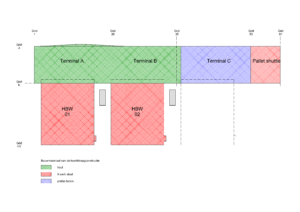
Although timber was not suitable everywhere, materials with the lowest possible CO₂ emissions were deliberately chosen for each section. In a future article, we’ll determine the building’s final LCA value and provide insight into the overall environmental performance of this unique distribution center. Stay tuned to our social media for another Bestseller update!